
Mindfulness Made Simple

The 300-Second Brain Reset: Why Micro-Mindfulness is the New Executive Edge
1. The Myth of the “Arduous” Practice
For the modern professional, time is the ultimate scarcity. “Busyness” has become a pervasive, often performative, trap. Yet, the cost of this hustle is staggering. Harvard University research reveals that we spend nearly 47% of our waking hours in a state of “mental fragmentation”—our attention drifting everywhere but the present.
This cognitive splintering is the silent architect of modern burnout. It leads to a state of emotional exhaustion that even the longest weekend cannot repair.
The primary barrier to entry is a persistent myth: that mindfulness requires a monastic commitment to the cushion. In reality, the emerging science of “micro-mindfulness” suggests that five minutes is more than a respite—it is a physiological game-changer. By reclaiming just 300 seconds of intentional awareness, we can fundamentally rewire our neurological baseline for resilience and high-stakes performance.
2. Takeaway 1: Your Brain Needs a “Push-Up,” Not a Nap
A common misconception among high-achievers is that meditation is a form of “zoning out”—a passive mental nap. On the contrary, it is a rigorous form of cognitive training. In neurological terms, it is a “push-up for the brain.” Rather than inducing emptiness, the practice actively strengthens neural connections and increases grey matter density in the hippocampus and prefrontal cortex—regions critical for learning, memory, and perspective-taking. When we reframe mindfulness as a cognitive workout rather than a relaxation technique, the ROI shifts from a temporary “chill” to long-term structural resilience.
“Mindfulness is paying attention; on purpose, in the present moment, and non-judgmentally.” — Jon Kabat-Zinn
3. Takeaway 2: The “Non-Striving” Paradox
In a world governed by KPIs and relentless achievement, the principle of “non-striving” feels counter-intuitive. We are conditioned to manipulate our environment and ourselves to reach the next milestone. However, mindfulness invites a “beginner’s mind”—a state of being open and curious rather than judgmental.
This paradox suggests that the most effective way to facilitate change is to first accept the present moment exactly as it is. Mindfulness isn’t about escaping a high-pressure meeting to find a “happy place”; it is about “turning towards” uncomfortable experiences with radical clarity. By acknowledging a difficult fact or a surge of anxiety without denial, you create the mental space necessary for a skillful, rather than reactive, professional response.
4. Takeaway 3: Shrinking the Amygdala in Five Minutes
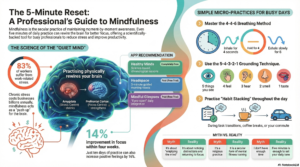
The impact of a consistent five-minute practice is etched into our neurological architecture. Research from the Black Dog Institute demonstrates that mindfulness physically shrinks the amygdala—the brain’s “fight or flight” center.
As the amygdala’s reactivity diminishes, the prefrontal cortex becomes more dominant. This moves a professional from impulsive reaction to thoughtful response, providing a biological shield in the workplace.
Case Study: A 2018 University of Surrey study found that regular meditators are less affected by negative feedback due to altered dopamine levels.
Real-World Result: At Aetna, employees reported significantly lower stress levels and higher job satisfaction after implementing mindfulness-based stress reduction.
5. Practical Synthesis: The On-the-Go Toolkit
The ultimate goal is “effortless mindfulness”—a practice compatible with the chaos of the office. You do not need a silent room; the key is bridging formal practice into daily activity.
- The 4-4-6 Breath: Inhale for four seconds, hold for four, and exhale for six. This rhythm activates the parasympathetic nervous system to instantly neutralize the stress response.
- Mindful Walking: During transitions between meetings, focus entirely on the sensation of your feet connecting with the ground. This boost in presence can increase creative thinking by up to 60%.
- The 5-4-3-2-1 Grounding Reset: In moments of overwhelm, identify 5 things you see, 4 you feel, 3 you hear, 2 you smell, and 1 you taste. This anchors the mind and interrupts anxious thought loops.
- Task-Integrated Awareness: Practice “eyes-open” mindfulness during routine tasks—like feeling the texture of your coffee cup—to break the autopilot cycle that leads to exhaustion.
6. Takeaway 4: Stop Trying to Empty Your Mind
Perhaps the most persistent myth is that mindfulness requires a “blank” mind. This creates an unnecessary barrier for high-functioning personalities. In reality, the mind is designed to think; mindfulness is simply the act of noticing the thinking.
Neurologically, this involves observing the Default Mode Network (DMN)—the brain’s “inner chatter” responsible for rumination. When you notice your mind has drifted and gently return to your anchor (like the breath), you are completing one “rep” of your brain push-up.
However, we must distinguish this from “McMindfulness”—the shallow use of these techniques as a “sticking plaster” for toxic environments. While five minutes is the gateway, the true transformation lies in sustained practice that builds lasting cognitive flexibility.
Conclusion: Beyond the Timer
The benefits of mindfulness are not found in the perfection of the session, but in the consistency of the habit. A regular micro-practice acts as a stabilizing anchor in an unpredictable professional landscape.
Remember: 47% of your life is currently slipping through the cracks of distraction. What leadership potential could you unlock if you reclaimed just 1% of that time? That single five-minute investment is more than a break; it is the most productive strategy in your arsenal.
Would you like me to adapt this into a specific format, such as a LinkedIn post with emojis or a one-page executive summary?
Try these techniques for at least a week and let us know in the comments what methods you mastered and how you use it.
Fell free to leave a comment for us. Tell us what is it you liked the most out of this.
Click this to read more of our bl0gs. Thankyou 🙂